


 AccessLex


With Federal Loan Limits Looming, Law Schools Need a New Playbook for Awarding Aid
Law school affordability has been a longstanding concern among legal education stakeholders. As one of the most expensive degree programs, scrutiny of the costs of J.D. programs is warranted. The discontinuation of Grad PLUS – the federal loan program that allowed graduate and professional students to borrow up to the cost of attendance – coupled with the federal loan caps imposed via the One Big Beautiful Bill Act (OBBBA) have exacerbated worry over students’ ability to pay for law school.
These changes are particularly troubling for individuals who have historically relied on federal student loans to finance large portions of their legal education. Many of them will not be able to qualify for loans in the private market, leaving a funding gap due to the new federal limits. But while loans are a critical tool for accessing higher education, they are only one side of the equation. Student aid granted from law schools is equally important because it directly affects how much students ultimately need to borrow.
Disparities in Student Aid Awards
For the 2024-25 academic year, Santa Clara University School of Law awarded grants to 61% of its J.D. student body. But after OBBBA loan caps were announced, the school made headlines when it announced a universal tuition discount for its incoming 2026 class of students – $16,000 for full-time students and $12,500 for part-time students. According to ABA Standard 509 data, 53 law schools awarded grants to 94% or more of their students during the 2024-25 academic year. This aid was significant: among these schools, the average median amount awarded to full-time students was about $27,000, and an average 40% of recipients received grants covering at least half of tuition. Although this aid was generous, it was not awarded proportionately.
Data disaggregating grant aid by student demographics tell a sobering story. In 2016, the Law School Survey of Student Engagement (LSSSE) explained how law school grant aid criteria most often center LSAT scores and undergraduate GPAs (UGPA), while sidelining demonstrated financial need. Unfortunately, these “merit” frameworks perpetuate inequity. Prevailing trends, particularly related to standardized test performance, ensure that recipients of the most generous awards more often have lower financial need than those who receive less aid, if any.
Aaron N. Taylor, Executive Director of the Center for Legal Education Excellence® at AccessLex Institute®, characterized this dynamic as a “Robin Hood, In Reverse” cost-shifting scheme. The neediest students – those who are least likely to receive lucrative awards – end up subsidizing the law school attendance of their more affluent classmates – those most likely to receive substantial awards. These subsidies are funded by loans borrowed by the neediest students.
This awarding practice drew additional critique in 2022 when Yale Law School, under the leadership of Dean Emerita Heather Gerken, announced its withdrawal from participation in the U.S. News & World Report “Best Law Schools” ranking survey. In the announcement, Gerken highlighted that the ranking methodology incentivizes law schools to prioritize aid in inequitable ways and admit students with less financial need.
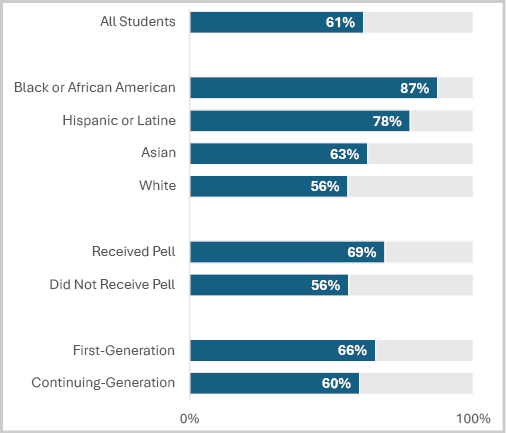
Disparities in student aid awards are not unique to law schools; they are prevalent across higher education, from undergraduate to graduate programs. A recent study from the National Association for College Admission Counseling (NACAC), using data from the U.S. Department of Education’s National Postsecondary Student Aid Study (NPSAS), found that higher income students are most likely to receive a grant from their institution, and that “merit” aid award amounts have increased significantly more than need-based grants. The NPSAS dataset also shows that law students who are people of color, former Pell grant recipients, or first-generation bachelor’s degree graduates receive less school-issued aid and rely more on loans to finance their education compared to other students (Figures 1 and 2).
Figure 1. Average Institutional Grant Aid as a Percentage of Total Aid Disbursed to Law Students, AY2019-20
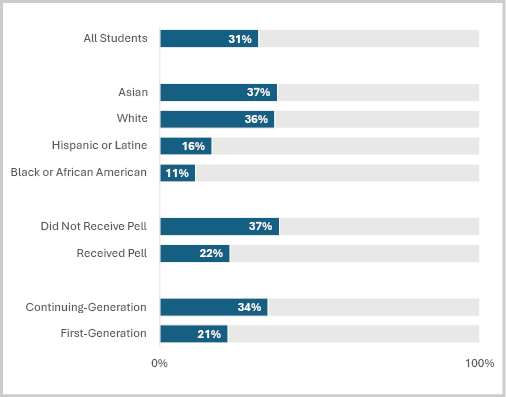
Figure 2. Average Loans Disbursed as Percentage of Total Aid Awarded to Law Students, AY2019-20
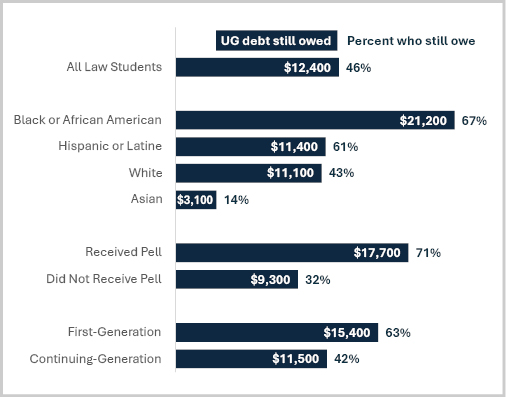
Disparities in aid awarded largely reflect disparities in the composition of aid packages. As Figure 3 shows, law students who are Black, Hispanic or Latine, former Pell grant recipients, or first-generation bachelor’s degree graduates are more likely to receive aid packages that include loans and less likely to receive packages that include grants, compared to other students. As a result, these students are required to take on more law school debt, adding to the inequitable amounts of undergraduate debt already incurred (Figure 4).
Figure 3. Composition of Average Aid Package Offered to Law Students, AY2019-20
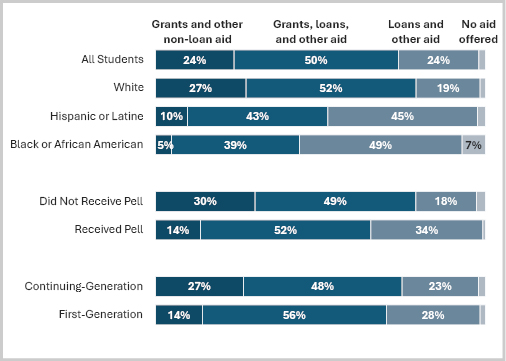
Figure 4. Undergraduate Debt Still Owed Among Enrolled Law Students, AY2019-20
Reimagining Institutional Grant Aid and Related Practices
Within the context of inequitable student aid awarding, OBBBA loan limits foster a bleak environment for law school access and affordability. New approaches to awarding school-based aid are needed. Fortunately, there are signs that law schools are actively pursuing solutions. Santa Clara’s announcement is one such example, and county support for Appalachian School of Law is a testament to how local and state governments can help sustain law schools that critically advance economic opportunity in their communities.
AccessLex Institute is also extending support, most recently with its Private Loan eXchange℠, a curated directory of vetted private and state-based lenders. And two law schools – University of Kansas and Washington University in St. Louis – recently introduced institutional loan programs as financing alternatives for students who need but do not qualify for private loans. With these initiatives in mind, below are a few other, non-exhaustive recommendations for mitigating the harmful effects of OBBBA loan limits.
Reconsider institutional aid awarding practices. Many law schools prioritize standardized test scores and UGPAs when awarding aid. Consequently, students from lower socioeconomic backgrounds receive fewer grants than their wealthier peers. Scholars and commentators have proposed a range of measures to reduce inequity in aid awarding, including the wholesale abandonment of “merit” aid in favor of need-based aid and the redefinition of merit, beyond test scores and UGPA. Factors such as obstacles overcome and commitments to public service are credible criteria for awarding grants and should be considered to provide more equitable opportunities for lower-income students.
Improve transparency around need-based aid availability. Although ABA-accredited law schools must report grant aid information on an annual basis, they are not required to disaggregate by aid type. Dean Emerita Gerken and University of Washington School of Law Dean Tamara F. Lawson urged the ABA to compile and disseminate need-based aid information to increase transparency. However, law schools can easily and voluntarily disclose need-based aid information by adding these details to their admissions and financial aid webpages. Our Show Them the Money report found that nearly half of ABA-approved law schools did not mention need-based grant aid on their websites, while 96% did so for “merit” aid. Full coverage of the availability of both grant types can help close information gaps for all students, especially first-generation and low-income students.
Resist the rankings game. Despite reduced participation in the U.S. News & World Report “Best Law Schools” survey, rankings continue to perniciously influence law schools. The ranking methodology now leans heavily on publicly available data instead of survey data alone, and weighs employment and bar passage rates much more heavily than selectivity factors. Nonetheless, law school selectivity correlates highly with outcomes, maintaining the incentive to base admission and grant aid decisions principally on test scores and UGPA. Loosening the rankings’ grip on law schools will require a significant cultural shift in legal education and the legal profession; but it is a worthwhile effort to ensure that all qualified aspiring law students can afford to attend. Looking to frameworks such as our value-added models, which reward law schools that outperform their expected bar passage and employment outcomes, is just one of many approaches we can take to better measure and esteem institutional impact.
Advocate for student aid policy that broadens access and affordability. Law schools must proactively engage in advocacy for federal student aid policies that facilitate enrollment, affordability, and loan repayment. For most law schools, this will require working with university governmental affairs staff to ensure issues affecting J.D. students are kept at the forefront of their conversations with policymakers. Data and stories that demonstrate the impact of student aid policies on law students are essential to this effort, along with those that showcase law schools’ contributions to their communities. Joining forces with other graduate and professional schools and empowering student advocacy can also be effective for amplifying the institution’s collective voice. Resources like our #MakeTheCase Advocacy Toolkit can help students and administrators reach policymakers effectively.
No Time to Delay
The new federal student loan landscape calls for a reexamination of law school aid awarding practices. Without reform, the discontinuation of Grad PLUS and the imposing of OBBBA student loan restrictions will worsen the damaging effects of unequal access to legal education.