


 AccessLex


Understanding the Path to Law School: Persistence Beyond the Application Cycle
This is the first in AccessLex Institute’s Understanding the Path to Law School series, which explores how underrepresented students navigate the complex and often non-linear pathway to law school. Across the series, AccessLex researchers examine the barriers, opportunities, and decision-making that shape students’ journeys to law school.
This piece was co-written by Jordan Spencer, Kelsey Risman, and Baylee Jenkins, Senior Research Analyst.
“How did you get to law school?” For many lawyers, the answer is not a straight line. Some people know from childhood that they want to practice law, with countless experiences and reinforcements, from an early age, that affirm their destiny to have an impact. Others discover the possibility later, somewhere along the career progression arc of high school to college to “What’s after college?” And still others arrive after years of low-paying, low-agency legal-adjacent work, temporary caregiving priorities, interrupted progress toward the bachelor’s degree, or as a result of a major career change. No matter when the idea first takes shape, the road to law school is rarely simple and undoubtedly paved with twists and turns along the way.
LexPreLaw is designed to support students whose journeys to law school may be delayed, complicated, or discouraged by structural barriers. The program exclusively serves aspiring law students who have historically been denied access to the resources that help applicants be seen as competitive.
Created in 2020, LexPreLaw began as a research-based effort to identify sustainable, effective ways to increase diversity in law school admission. The program removes key barriers by providing participants with a full-length commercial LSAT preparation course at no cost, financial assistance during the application cycle, access to supportive peers and professionals, and, for some participants, individualized admission counseling.
During the program year, participants work to raise their LSAT scores, strengthen their application materials, and apply to law schools. Since 2021, 135 participants have matriculated into law school after receiving LexPreLaw support, and 84% of those matriculants completed their first year of law school in good academic standing. These outcomes are especially meaningful because all LexPreLaw participants began the program with an LSAT score at or below the 25th percentile as a condition of eligibility. Without intervention and support, such LSAT scores likely would have prevented participants from receiving any law school admission.
These early outcomes point to LexPreLaw’s promise in identifying talented students who, with support, are ready to succeed in law school, but they capture only part of the story. While LexPreLaw participants’ admission rates are notable, each year there are dozens of talented and motivated participants who do not receive a law school admission offer during the program.
Looking Beyond Immediate Admission Outcomes
To better understand how unadmitted participants continued navigating the road to law school after their program cycle, we recently surveyed all prior participants who did not have a record of law school admission during their program year. Their responses offer a fuller picture of how the program’s support may continue shaping students’ pathways over time.
Specifically, we present three connected findings: first, that a notable proportion of program alumni had a delayed matriculation; second, that there is sustained interest in law school among past participants; and third, that there is widespread confidence in the relevance of the program’s support, even among prior participants still seeking an admission.
Many Participants Reach Law School on a Delayed Timeline
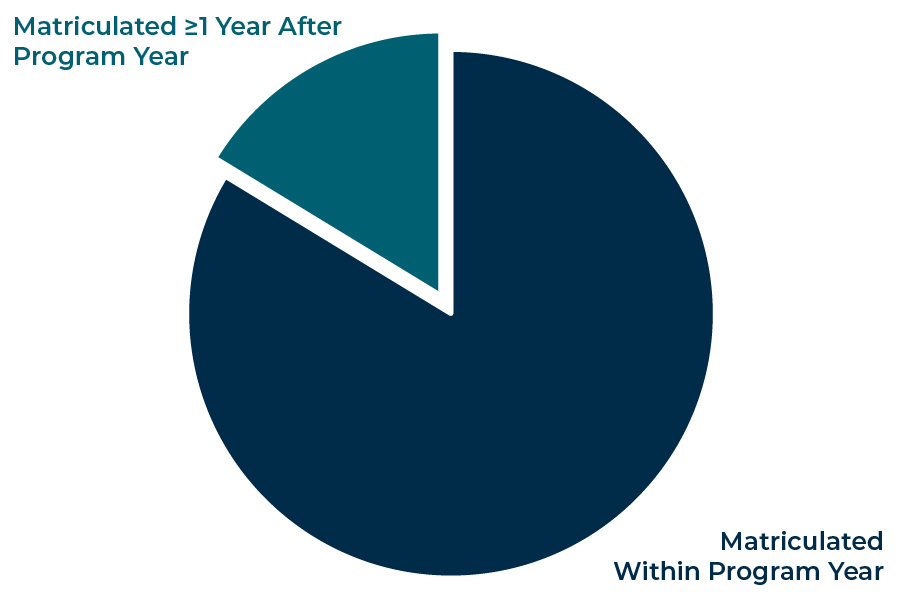
While the vast majority of LexPreLaw participants matriculate to law school during their intended semester, a sizable portion, 16%, matriculate one or more years later (see Figure 1). These participants matriculated, on average, roughly two and a half years after they intended to. Their longer timeline demonstrates the reality many under-resourced individuals face pursuing postgraduate career aspirations. This subgroup of matriculants received program support but may have needed more time to develop stronger candidacies or determine which opportunities best aligned with their goals.
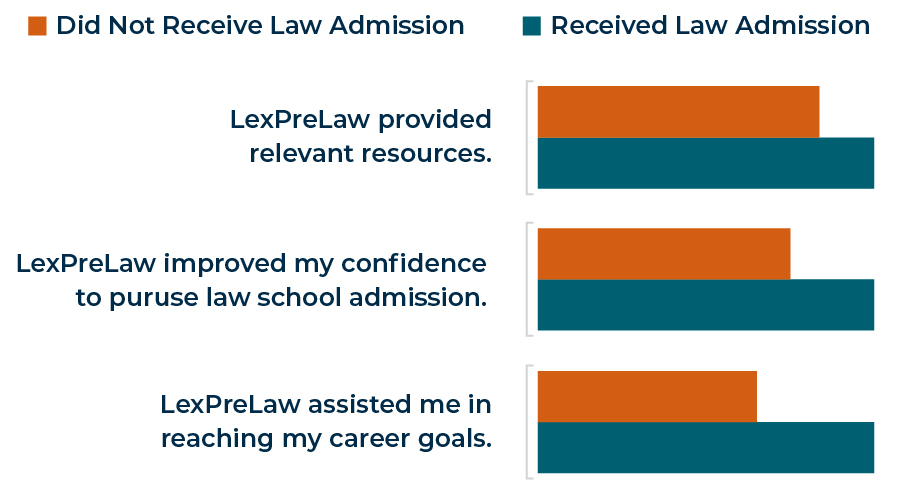
Even with these delays, over 90% of past participants agreed that LexPreLaw provided relevant resources, improved their confidence to be successful, and assisted them in reaching their career goals (see Figure 3). These findings suggest that LexPreLaw’s impact may extend beyond immediate admission outcomes by providing an iterative form of support that former participants can draw on as they refine their goals and persist toward law school beyond their program year.
Most Participants Still Plan to Pursue Law School
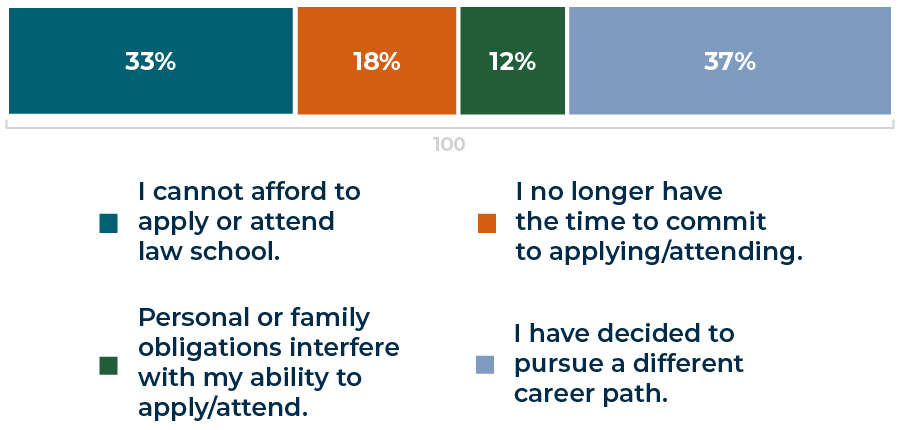
The survey also revealed that among the respondents who have yet to receive an admission offer, 85% reported that they remain interested in attending law school. These individuals represent a substantial pool of untapped talent who, despite being multiple years into their pursuit of law school, still have not abandoned their ambitions. Among the 15% of respondents who reported they were no longer interested in law school, most indicated that something other than a decision to change their career path was the primary factor influencing their decision (see Figure 2).
Former Participants Continue to See Value in LexPreLaw
Satisfaction with LexPreLaw programming remained high even among past participants who have not yet received a law school admission. Seventy-seven percent agreed that LexPreLaw provided them with relevant resources, 69% agreed the program improved their confidence to pursue law school, and 60% agreed that LexPreLaw assisted them with their career goals.
Supporting Students Throughout the Full Road to Law School
Taken together, these findings show that LexPreLaw’s impact does not end when a program year closes.
For many underrepresented aspiring law students, the road to law school is non-linear and longer than a single admission cycle. Support that builds preparation, confidence, and persistence may continue to matter well after formal pathway programming concludes.
For LexPreLaw and similar pathway programs, success should not only be measured by immediate admission outcomes: long-term persistence, delayed matriculation, and sustained interest in law school are also meaningful indicators of impact and efficacy. As the legal profession continues working to broaden access, programs like LexPreLaw remain essential to identifying talent, reducing barriers, helping talented students stay the course, and supporting aspiring students along the full road to law school.
Learn more about LexPreLaw and AccessLex Institute’s LexScholars pathway initiative.